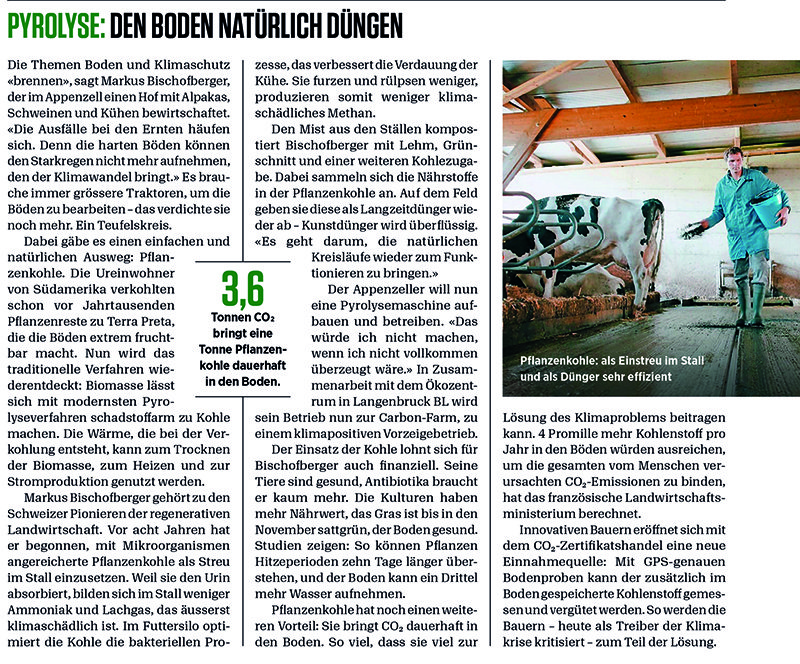
PYROLYSE: FERTILIZE THE SOIL NATURALLY
In 2020, Beobachter magazine published an in-depth article series on the topic of Smart Farming for the future.
We were proud that our own farm and our visions on carbon farming became part of this innovative series. Markus has been described as one of Switzerland's pioneers in the field of regenerative agriculture.
Under the title: PYROLOSE: Den Boden Natürlich Düngen on page 20 of the Beobachter Magazine Edition 1/2020 the journalist Julia Hofer brought our visions to print with the below article (strangely enough the Beobachter has used a photo of a stranger and his farm rather than our own farm)
"PYROLYSE: FERTILIZE THE SOIL NATURALLY"
The topics of soil and climate protection “are igniting”, says Markus Bischofberger, who runs a farm with alpacas, pigs and cows in Appenzell. “Harvest failures are increasing. because the hard soils can no longer absorb the heavy rain that climate change brings. »It takes more and more tractors to work the soils which makes the soils even more compacted thus creating a vicious circle. There is a simple and natural way out: Biochar. The indigenous people of South America made Terra Preta from charred plant remains millenniums ago, which makes the soil extremely fertile. This traditional process is now being rediscovered: using the latest pyrolysis processes, biomass can be converted into plant coal with low emissions. The heat generated by charring can be used to dry the biomass, be used as a heat source and to produce electricity. Markus Bischofberger is one of the Swiss pioneers in regenerative agriculture.
Eight years ago (2012) he started using biochar enriched with microorganisms as bedding for his livestock in the barn. Because it absorbs the urine, less ammonia and nitrous oxide are formed in the barn, which is extremely harmful to the climate. In the feed silo, the biochar optimizes the bacterial processes, which improves the digestion of the cows. They flatulate and belch less, producing less climate-damaging methane. Bischofberger composts the manure from the stables with clay, green waste and additional biochar. The nutrients accumulate in the biochar and in the field, they release these nutrients as a type of slow-release fertilizer – making artificial fertilizer superfluous. "The point is to get the natural cycles working again." The Appenzeller now wants to build and operate a pyrolysis machine. "I would not do that if I was not completely convinced." In cooperation with the eco center in Langenbruck BL, his business is now becoming a carbon farm - a climate-positive model business.
The Appenzeller now wants to build and operate a pyrolysis machine. "I would not do that if I was not completely convinced." In cooperation with the eco center in Langenbruck BL, his business is now becoming a carbon farm - a climate-positive model business. The use of biochar is also financially worthwhile for Bischofberger. His animals are healthy, he hardly needs any antibiotics anymore, the harvests have more nutritional value, the grass is luscious green until November, and the soil is healthy. Studies show that plants can survive heat periods ten days longer and the soil can absorb one third more water.
Biochar has another advantage: it binds CO2 permanently into the soil. At such levels that it can do a lot to solve the climate problem. The French Ministry of Agriculture has calculated that 4 per mil more carbon in the soil per year would be sufficient to bind all man-made CO2 emissions. The CO2 certificate trade opens up a new source of income for innovative farmers: GPS-accurate soil samples can be used to measure for the additional carbon stored in the soil and compensate them accordingly. In this way, farmers - criticized today as drivers of the climate crisis - are becoming part of the solution.
"One ton of biochar binds 3.6 tons of CO2 into the soil indefinitely".