ALPACA HUSBANDRY
What Really Matters in Alpaca Husbandry
Alpaca husbandry in Switzerland
Alpacas are considered low-maintenance animals, but good Alpaca Husbandry does not begin in the barn or on the pasture—it starts with proper planning. Species-appropriate husbandry forms the foundation for healthy animals, calm group dynamics, and a stable, long-term herd.
From our daily practice, we know that it is often not major mistakes that matter most, but small details in husbandry, space requirements, and group structure. On this page, you will find the key principles of Alpaca husbandry in Switzerland —clearly structured, easy to understand, and based on practical experience. Further information can also be found in our Alpaca Facts.

The Key Principles of Alpaca Husbandry
Successful alpaca husbandry is not based on individual measures, but on the interaction of several fundamental elements.
Herd Animals
Alpacas need social contact and a well-structured herd.
Shelter & Housing
Protection from weather is essential – all animals must have access at all times.
Grazing Area
Area, quality, and pasture management determine long-term sustainability.
Enclosures & Fencing
Secure fencing protects the animals and must suit the environment.
Herd animals – why group structure matters
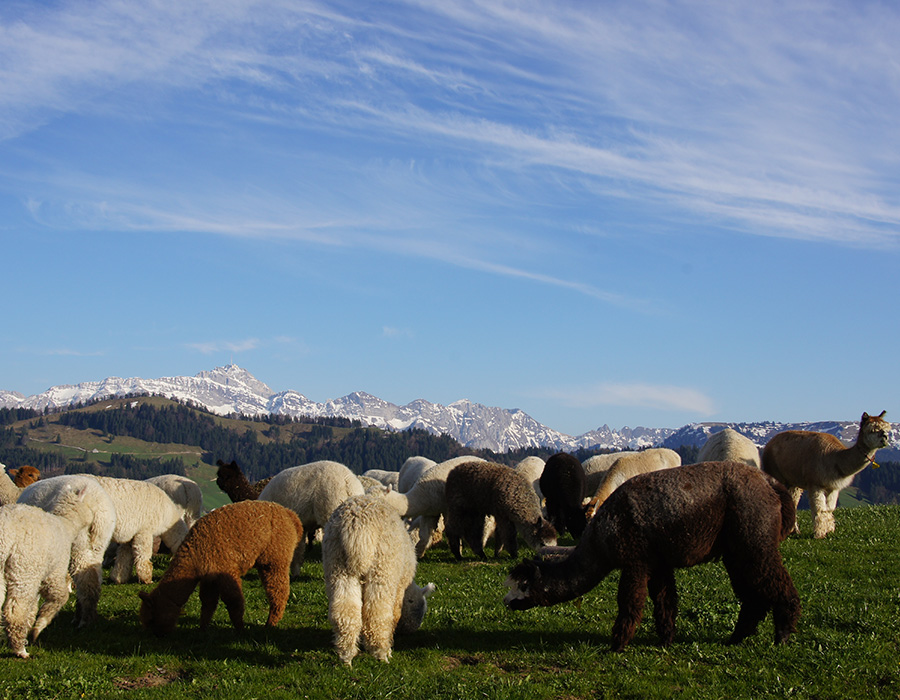
Alpacas are highly social herd animals and must not be kept alone. Proper husbandry requires at least two animals with social contact.
In practice, it quickly becomes clear that not only the number of animals matters, but above all the composition of the group. Calm and stable herd structures have a positive effect on behaviour, stress levels, and the overall wellbeing of the animals.
In many cases, two or more males or females are kept together. Geldings can also be well integrated depending on the situation. Keeping males and females together on a permanent basis is generally not recommended. For breeding, the male is introduced in a controlled and targeted way.
When planning a new herd, it is worth considering the future group structure from the very beginning.
Behaviour & communication – how alpacas express themselves
Alpacas are biologically classified as prey animals, yet they also show a strong defensive behaviour towards smaller predators. They may actively drive away foxes or dogs and are even used as guardian animals in some countries.
At the same time, their natural instinct is to hide weakness for as long as possible. Understanding this behaviour is essential for working with alpacas and managing them on a daily basis.
Alpacas communicate in a very quiet and subtle way. Compared to other livestock such as sheep or goats, they are much less vocal and often express changes through behaviour and body language rather than sound.
A typical sound in a relaxed herd is a soft humming, which can often be heard while grazing or resting in the shelter. It is generally considered a sign of calmness and wellbeing.
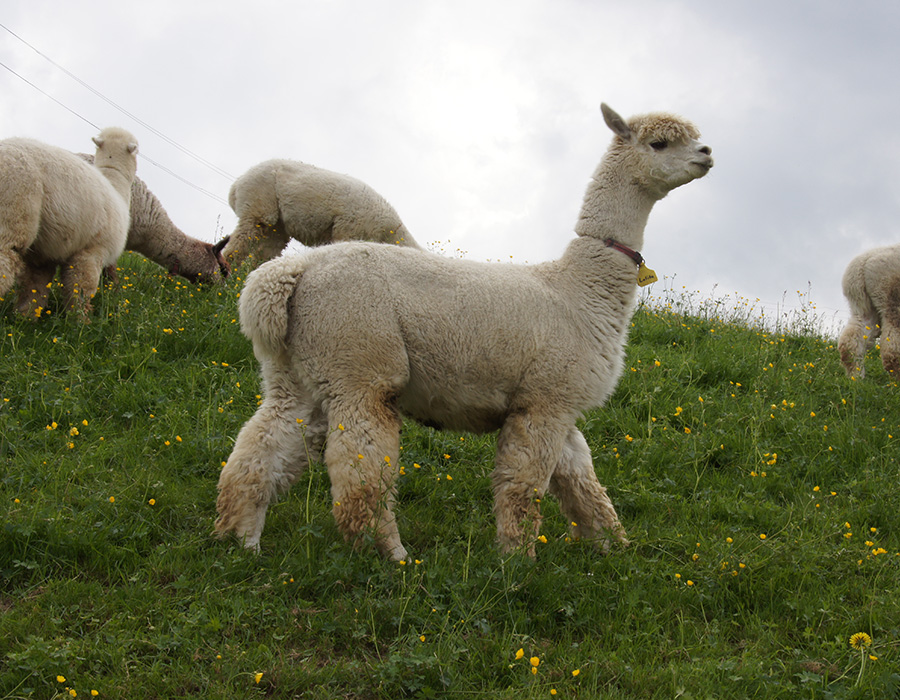
When alpacas sense a potential threat, their behaviour changes noticeably. They raise their heads, become very alert, and observe their surroundings in a calm but focused way.
Often, one animal—usually a higher-ranking or particularly attentive individual—takes on a leading role and signals to the rest of the herd that something is not right. The other animals respond by directing their attention in the same way.
If the threat increases, alpacas may produce a loud, high-pitched alarm call, somewhat similar to a donkey’s bray. This sound alerts the herd and focuses attention on the potential danger.
Spitting – a natural form of communication
One of the most common questions is whether alpacas spit.
Yes, alpacas do spit—but always for a reason. It is primarily a form of communication and defence.
Within the herd, it is used to establish hierarchy or to keep other animals at a distance. In most cases, this involves a light spit consisting mainly of saliva.
In more intense situations, such as stress, pressure, or defence, an alpaca may regurgitate stomach contents and spit more forcefully. This is referred to as regurgitated stomach content.
This behaviour occurs mainly:
- during conflicts within the herd
- when pregnant females fend off males
- n stressful situations, for example during veterinary treatment
When animals are handled calmly and respectfully, this behaviour is rarely directed at humans.
Their calm behaviour and soft humming make spending time with alpacas especially relaxing.
Dust bathing – natural behaviour and an important part of care
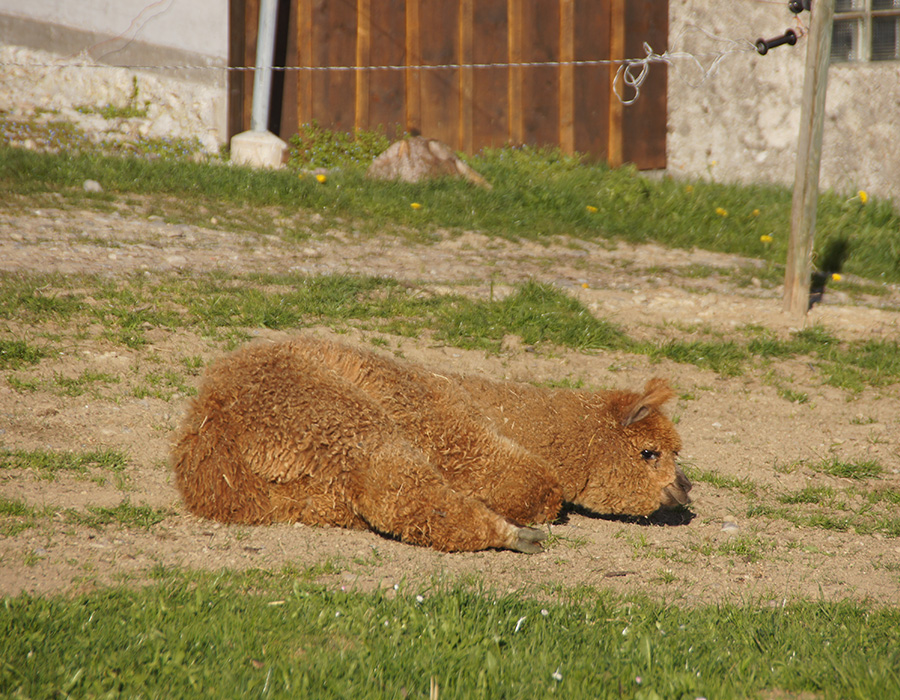
Alpacas have a strong natural instinct to dust bathe regularly. This behaviour is a natural part of their grooming and important for their overall wellbeing.
Dust bathing helps to loosen the fleece, remove dirt, and improve air circulation to the skin. At the same time, it naturally supports parasite control and contributes to healthy skin.
Alpacas often create their own dust bathing areas by removing the top layer of soil until a dry, loose—often sandy—surface forms. These spots are used regularly.
Typical locations are slightly elevated, well-drained areas that remain dry even in wet conditions.
A suitable dust bathing area:
- is dry and well drained
- has a loose, preferably sandy surface
- is easily accessible for all animals
If no suitable area is available, alpacas will create one themselves—clearly showing how important dust bathing is for them.
If they are lacking over time, this can negatively affect fleece condition, skin health, and overall wellbeing. They are closely linked to fleece care, skin health, and parasite management. → Learn more about Alpaca Health
Shelter & housing in alpaca husbandry – protection and a place to retreat
In alpaca husbandry, animals need not only sufficient pasture but also a suitable shelter. Keeping alpacas permanently in a barn is not permitted, as they require daily movement and access to grazing areas.

Open shelter systems are particularly well suited for alpacas. They allow the animals to choose whether to stay inside or outside, supporting natural behaviour and helping to maintain a calm herd.
Die gesetzlichen Mindestanforderungen betragen mindestens 2 m² of shelter space per animal sowie eine Mindesthöhe von 2 Metern. Entscheidend ist jedoch nicht nur die Fläche, sondern auch die Zugänglichkeit. Alle Tiere müssen den Unterstand jederzeit nutzen können, ohne von ranghöheren Tieren verdrängt zu werden.
A well-designed shelter plays an important role in reducing stress and protecting the animals in changing weather conditions.
Pasture area – more than just minimum requirements
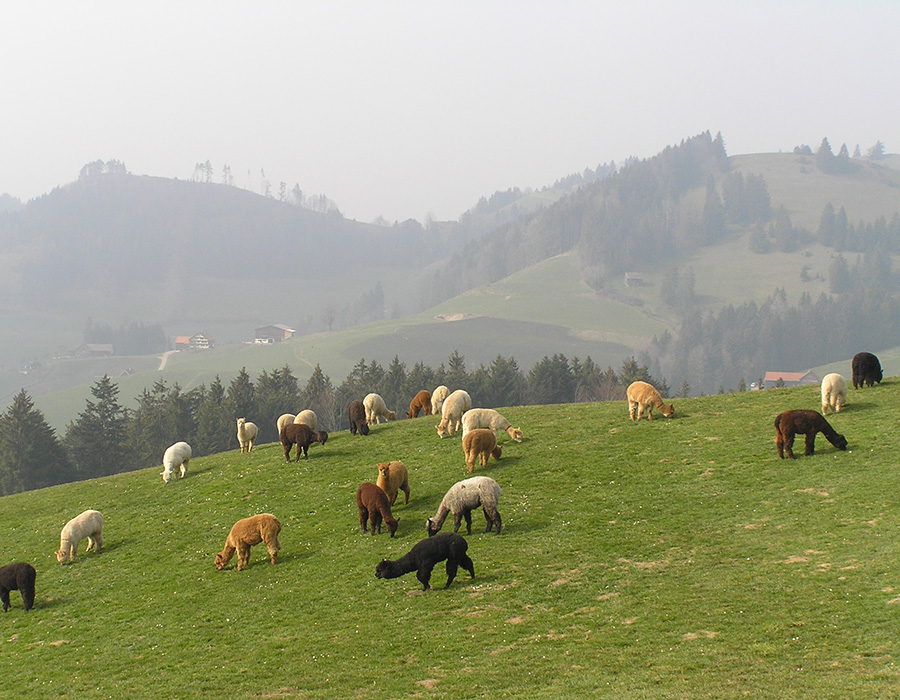
For a functional pasture system, significantly more space is needed. As a guideline, around 600 to 800 m² per animal is recommended to ensure sufficient feed and sustainable pasture use.
Alpacas are classified as livestock and are calculated in livestock units (LU). Animals under two years correspond to about 0,07 GVE, while adult animals correspond to around 0,11 GVE. This results in approximately 9 to 15 animals per hectare , depending on use and location.
However, it is not only the size of the pasture that matters, but also its quality, how it is managed throughout the year, and how it is adapted to the specific site and weather conditions.
Fencing & enclosures in alpaca husbandry – safety and adaptation
Pasture areas for alpacas must be securely fenced to protect the animals and prevent them from escaping. Various fencing systems can be used, such as woven wire, mesh fencing, or electric fencing.
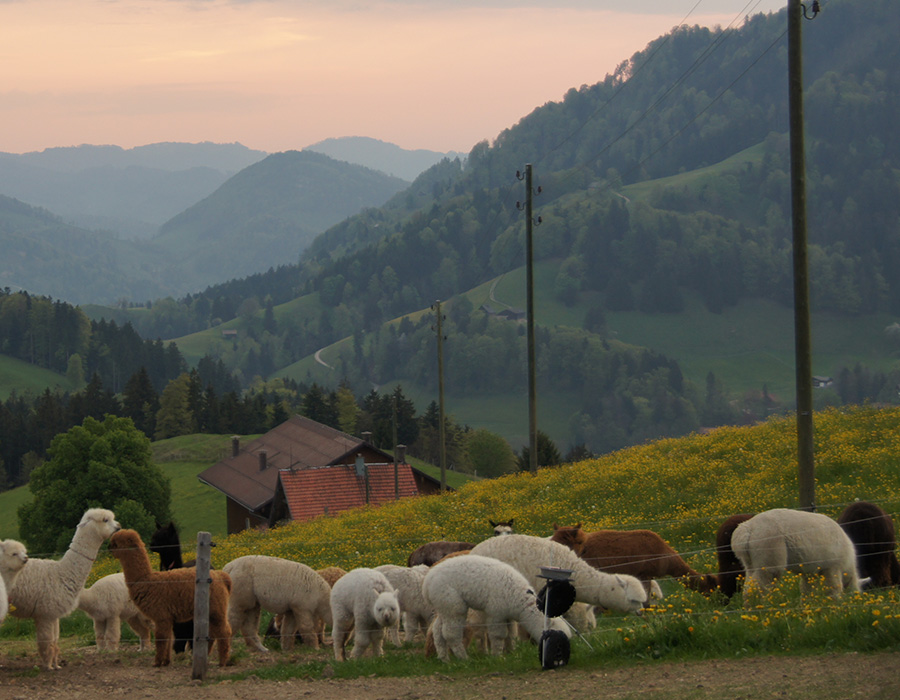
As a general guideline, the fence should be around 1m bis 1,30m high. It is equally important that the animals cannot jump over it or slip underneath. A clean and stable fence layout is therefore essential.
With electric fencing, it is important that the animals respect the fence. The wires should be positioned at appropriate intervals to ensure reliable effectiveness.
The choice of fencing depends largely on local conditions—particularly terrain, usage, and herd structure.
Common mistakes in alpaca husbandry
Many problems in alpaca husbandry develop gradually—not through major mistakes, but through small weaknesses in day-to-day management. Those who understand their animals well can recognise these early and take targeted action.
Insufficient pasture space
If space requirements are underestimated, the pasture will suffer over time and feed shortages can occur more quickly.
Unstable herd structure
An unsuitable group composition can lead to stress, unrest, and conflicts within the herd.
Inadequate shelter
If the shelter is poorly located or difficult to access, it will not be used equally by all animals.
Feeding is underestimated
It is not only the pasture that matters—feed quality, supplementation, and seasonal adjustments are equally important.
Health and parasites
Changes are often noticed too late. Regular observation helps to identify problems at an early stage.
Small weaknesses are easily overlooked in everyday management, but can have a significant impact over time.
Training and legal requirements for alpaca husbandry in Switzerland
Alpaca husbandry in Switzerland is governed by the Animal Welfare Ordinance (TSchV), in particular Article 194.
Anyone who keeps or cares for alpacas must have appropriate training.
An agricultural qualification with a focus on animal husbandry is sufficient to keep alpacas.
→ In this case,
→ In diesem Fall ist no additional certificate of competence (SKN) is required, regardless of the number of animals.
With the revision of the Animal Welfare Ordinance on 20 December 2024, these requirements were clarified:
Agricultural qualifications must include a clear focus on animal husbandry.
Other qualifications are only recognised if they are specifically related to the respective type of animal keeping.
Persons without an agricultural qualification can keep alpacas with a certificate of competence (SKN) .
However, this is limited to a maximum of 10 livestock units (LU) .
Those who were already keeping alpacas before 1. September 2008 are not required to obtain additional training.
In addition, animal keepers must register their livestock in the Animal Movement Database (TVD) ). This registration ensures traceability and supports animal health.
Detailed requirements can be found on the official website of the Federal Food Safety and Veterinary Office .
Frequently asked questions about alpaca husbandry
The following answers provide a brief overview of common questions about alpaca keeping, space requirements, behaviour, and day-to-day handling.
Alpacas are highly social herd animals and should not be kept alone. Proper husbandry requires at least two animals with social contact. In practice, however, it is not only the number that matters, but above all a calm and well-matched group structure.
Legal minimum requirements define the minimum space needed. For a functional and sustainable pasture system, significantly more space is usually required. In many cases, around 600 to 800 m² per animal is used as a practical guideline.
Yes, alpacas do spit—but always for a reason. It is primarily a form of communication and defence. Within the herd, it is often used to establish hierarchy or to keep other animals at a distance.
When handled calmly and respectfully, this rarely happens. Alpacas usually only spit when they feel threatened, stressed, or uncomfortable.
When alpacas notice a potential threat, they raise their heads, observe their surroundings very attentively, and often react together as a herd. In more serious situations, a clearly audible alarm call may occur.
A shelter protects the animals from sun, rain, and wind and is an essential part of proper alpaca husbandry. Not only the size matters, but also that all animals can access it at any time without restriction.
This behaviour, known as dust bathing, is a natural part of grooming and overall wellbeing. It helps to loosen the fleece, remove dirt, and improve air circulation to the skin. At the same time, it supports natural parasite control.
Yes, dust bathing areas are an important part of proper husbandry. If no suitable area is available, alpacas will often create one themselves by scraping away the top layer of soil until a dry, loose surface forms.
Alpacas show defensive behaviour towards smaller predators such as foxes or dogs and are used as guardian animals in some countries. However, they are not effective protection against larger predators such as wolves.